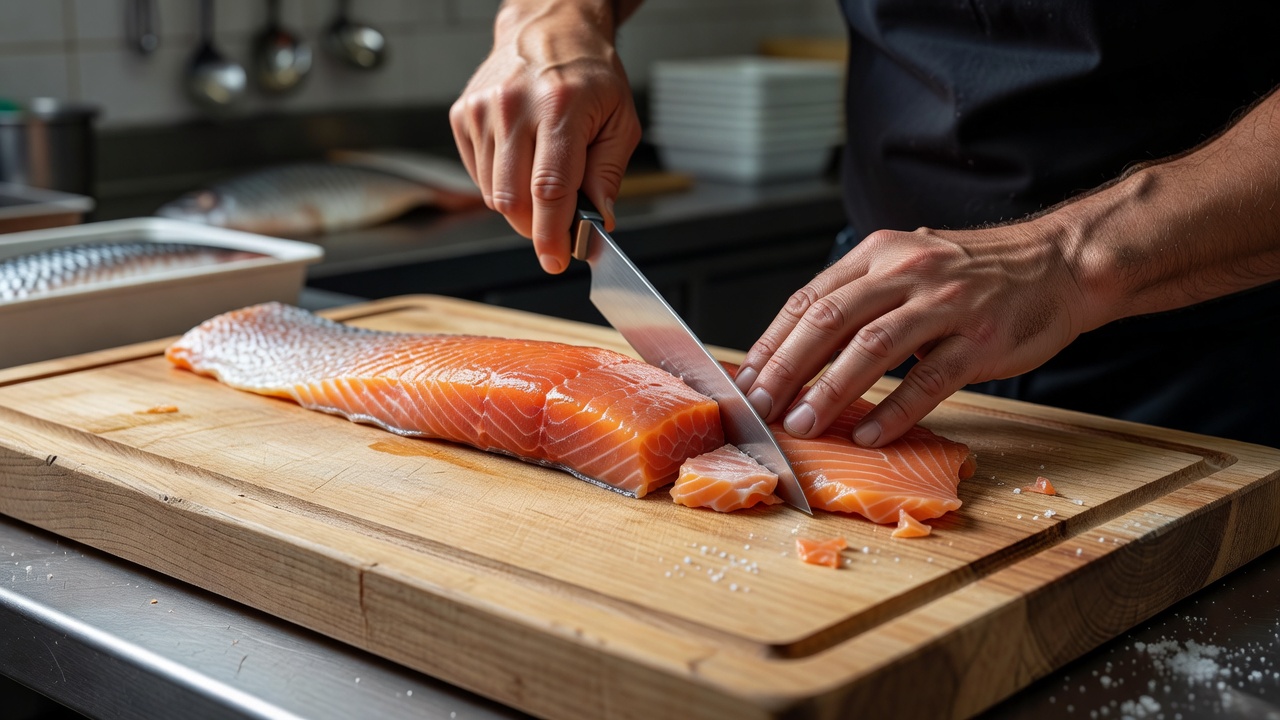
A useful purchase begins with a clear name. “Smoked fish” covers products that differ in species, cure, cooking status and packaging. Two packs that look similar may need different treatment. Take enough time to identify what the product actually is before deciding whether it suits your meal, journey and household.
Identify the fish and the process
Look for the species and the description of the product. Salmon, trout, herring, cod and haddock are not interchangeable ingredients, and smoking does not remove fish allergens. Check the ingredients and allergen information, including any additions used in a cure, glaze or accompanying sauce.
Next establish whether the fish is ready to eat or requires cooking. Cold smoking does not itself provide a cooking-equivalent heat treatment, but some cold-smoked products are manufactured and sold as ready to eat. Conversely, many smoked cod and haddock products need cooking. “Smoked” alone is not an instruction.
If buying loose fish, ask for the same practical information you would expect on a pack. Request preparation and storage advice in a form you can retain. Do not rely on remembering a hurried conversation after a long journey.
Separate origin from the smoker’s address
A business address tells you where a responsible operator is located, not necessarily where the fish was caught or farmed. A phrase such as “smoked in Scotland” describes processing location. It should not be read automatically as a statement about the origin of the salmon.
The precise information required on a label depends on the product category and applicable law. If sourcing matters to your decision, ask directly about the species, catch or farming origin and traceability. Avoid assuming that every prepared seafood product carries the same origin details as an unprocessed fish at a fishmonger’s counter.
Understand what a named scheme does
Protected geographical names define particular products and their connection to place. Arbroath Smokies and Grimsby Traditional Smoked Fish are useful examples, but the protection does not amount to a universal score for flavour, sustainability or nutritional value. Read what the designation actually covers.
Environmental certification answers a different question. The Marine Stewardship Council and Aquaculture Stewardship Council operate different schemes relevant to wild-caught and farmed seafood respectively. When a logo appears, check its context and traceability rather than treating it as a guarantee of every aspect of the finished food. Neither a sustainability label nor a geographical name replaces safe storage instructions.
Read dates and refrigeration instructions together
A use-by date concerns safety. Do not eat a product after that date, even if it smells normal. Harmful bacteria cannot always be detected through appearance or odour. A best-before date has a different purpose, principally relating to quality, but the product’s storage instructions still apply.
The stated shelf life assumes the required conditions have been maintained. A sealed pack that has spent too long outside those conditions does not become acceptable simply because its printed date is still in the future. If you are unsure about a temperature excursion, consult the supplier or a competent food-safety authority rather than improvising an extension.
Opening the pack can shorten the usable period. Follow the specific after-opening instruction and the original use-by date, whichever requires earlier consumption. There is no single number of days suitable for every smoked seafood product. Record the opening date if that helps your household follow the instructions.
Plan the journey before paying
Buy chilled seafood near the end of a shopping trip and use suitable insulated transport with cooling packs when needed. On a food-focused holiday, decide how the purchase will remain cold during travel and at your accommodation. A car boot, hotel room or sunny harbour bench is not a refrigerator.
For delivery, read the supplier’s receiving and refrigeration instructions and inspect the package promptly. Contact the supplier if packaging is damaged, the seal is compromised or the contents do not appear to have arrived under the stated conditions. Do not taste questionable fish to investigate whether it is safe.
Consider who will be eating it
Ready-to-eat smoked fish can present a particular concern for people vulnerable to listeriosis. Pregnant people and people with weakened immune systems should consult current national advice. UK Food Standards Agency guidance advises these groups to avoid ready-to-eat cold-smoked or cured fish unless cooked until steaming hot throughout. Other authorities may frame their advice differently.
Hot-smoked products also need appropriate handling; the name alone does not answer every question about risk after production. Where a household member has specific health needs, use relevant professional advice rather than a general food-travel article.
Freeze only with suitable instructions
Check whether the product is suitable for home freezing and whether it was previously frozen. Freeze within the permitted period, follow the manufacturer’s directions and thaw under the recommended conditions. Freezing is not a way to make spoiled food safe or to disregard a use-by date that has already passed.
With the practical questions settled, choose by taste and intended use. Ask for a description of salt level, texture and smoke character. A firmer hot-smoked fish may suit a warm dish; delicate slices may suit a cold preparation. Let that preference follow a sound understanding of the product, not replace it.